PRONOUNCER: (ā-nish-in-gnaw-beck-)
By:
Angela Lavallee
After two and a half decades, First Nations across Ontario have the opportunity to break away from sections of the Indian Act with a ratification vote to form a new Anishinabek Governance Agreement commencing Feb 1 -29, 2020.
Let’s do this!
The slogan used by the Anishinabek Nation for the new Governance Agreement is meant for the members to think about the future and have the chance to self-govern themselves to become the nation elders envisioned many years ago.
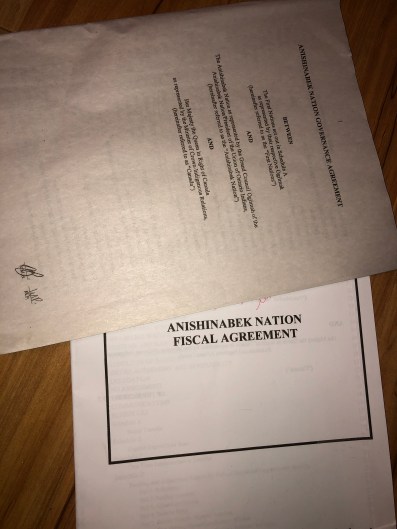
At a historic signing in July 2019 Grand Council Chief Glen Hare of the Anishinabek Nation (AN) and Carolyn Bennet Minister of Crown-Indigenous Relations signed the new Anishinabek Governance Agreement(AGA) to make the new agreement official.
So far, 15 First Nations are ready to vote in February, where eight are not. The AN has said those First Nations will hold a ratification vote in May 2020. Coincidently, in 2004, self government was proposed by the AN, where all First Nations in the AN opted out of self-government at that time , but now there is another chance for them to take on a small form of self-government.
“I am very excited about this agreement. It’s a good thing for us and now Canada will stay out of our law making decisions,” said Grand Council Chief Glen Hare at January 2020 meeting with Chief and Council of Curve Lake First Nation.
Grand Council Chief Glen Hare of the Anishinabek Nation and a citizen of M’Chigeeng First Nation is visiting First Nation communities across Ontario to talk about the Governance Agreement, why it’s an important step to take, and a necessary one.
The four areas the leaders of the Anishinabek Nation have established under the AGA are leadership, citizenship, language and culture, and government management. The First Nations who ratify will move away from Sec. 8-14 including Sec. 74-80 according to the AN.
However, Elder, Dr. Keith Knott, who told his community recently says before his First Nation can think about going any further, his and every First Nation need their own constitution.
“We need to start standing on our own two feet,” said Dr. Knott to his community on January 25, 2020. “We should be tired of the federal government telling us where to go, when to go, how to do this, how to do that, it’s no more. We need to develop our own laws. This is important and we must band together,” he urged.
Band council for Curve Lake First Nation says their constitution is almost ready and has been made public for a few years but has since got through some re-wording. The community will have the opportunity to vote on the new constitution when it is complete.
“We’ve had to do some edits,” said Councillor Saga Williams at the same community meeting. “We need to get this right.”
Knott says a constitution for any First Nation is a document that belongs to the First Nation and no one else. He also said it’s vital document that would hold up in court of law.
“It is a document that is for us and it tells everyone who we are. Eventually it will be translated into our language,” added Dr. Knott.
Dr. Knott is a former Chief and councillor for Curve Lake First Nation and has many years of experience in on-reserve and off-reserve politics.
27 First Nations have completed their constitutions, according to the AN website.
It’s not a new endeavour. The Anishinabek Nation already has an agreement with the Government of Canada for the new Education Kiinoomaage or Anishinabek Education System, (AES). That agreement was signed in 2015 where the door was left open for those First Nations who are not ready to come on board can so at a later time.
The same is for the new Anishnabek Governance Agreement.
“When the time is right for the First Nation to come and join the AGA, they can,” said Grand Council Chief Hare.
The fiscal agreement will have a 7x funding increase for self- governance.
The fiscal offer was signed in June 2019 along with the new Governance Agreement. The Anishinabek Nation Fiscal Agreement goes along side the AGA and is for the government of Canada to realize the law making decisions each First Nation will make in the four areas and respect and with no interference whatsoever. The AGA is a 5 year agreement where after can be re-negotiated.
Each First Nation who ratifies the AGA vote will receive no less than $1.7 million. Those First Nations who are larger would receive more. In addition, each First Nation will receive $548,000 to implement the new AGA this according to Chief Governance Negotiator Martin Bayer.
Bayer has also held online live information sessions for those who cannot make it to a community meeting. He says the process after ratification is for the Governance Agreement to enter House of Commons, voted on and made law. He also said he would like to see it the Government of Canada form the Anishinabek Nation Agreement Act.
Eligible voters can cast their ballot by mail-in, using the electronic platform One Feather or in-person at a polling station on the selected ratification date.
Other Chiefs
Lake Huron Regional Chief Scott Mcleod says with this new Governance Agreement there will be a learning aspect, but believes this is the right time and the right move for First Nations in Ontario to finally take on their own laws.
“We have to start. We cannot go on with the way things are now.” he said in a public forum held on January 28, 2020 from North Bay.
Former Chief of Alderville First Nation and Southeast Regional Deputy Grand Council Chief Jim Marsden says even though his First Nation declined the self-government in 2004, he says since then many issues that were questioned in 2004 were resolved and he says all should vote yes for the new Anishinabek Governance Agreement.
FNLMA and the new Governance Agreement
Two agreements mirror one another. Some First Nations who are holding a vote for the Governance Agreement have previously signed a First Nation Land Management Act (FNLMA), where areas are under that agreement are the same as the four of the AGA. Bayer says the FNLMA and AGA will work together in conjunction with each other.
 Nation 2 Nation News
Leave a comment